Logan's Run (1976)
MGM· USA· 120 min· English
Directed by Michael AndersonMusic by Jerry Goldsmith
Synopsis
In a domed city of endless pleasure centuries after civilization's collapse, every citizen lives in comfort until the age of thirty — at which point they're required to submit to Carousel, a ritual execution disguised as reincarnation. Logan 5, an enforcer tasked with hunting down citizens who try to run rather than submit, is ordered to go undercover as a runner himself — and begins to question everything his society has told him about what actually happens after the crystal in his palm turns black.
Advertisement
Review
Adapted from William F. Nolan and George Clayton Johnson's novel, Logan's Run imagines a hedonistic, fully computer-administered domed society that has solved overpopulation and resource scarcity through one brutal, unquestioned trade-off: nobody is permitted to grow old. It's a premise built explicitly for visual spectacle, and MGM spent accordingly for a mid-decade genre picture — the film won a Special Achievement Academy Award for its visual effects, built around genuinely striking matte paintings and detailed miniature cityscapes that gave 1976 audiences a vision of enclosed, climate-controlled utopia unlike almost anything else playing in theaters that year.
Michael York carries Logan 5's transformation from true believer to skeptic to outright fugitive with real conviction, playing a character whose entire identity as a loyal enforcer has to be dismantled and rebuilt over the course of the story. Jenny Agutter's Jessica 6 gives the film's second half genuine emotional stakes as the two runners flee together toward a mythical "Sanctuary" that may or may not actually exist beyond rumor, and Agutter's searching, questioning energy — already an established young actress from The Railway Children and Walkabout — helps drive the central conspiracy plot forward without the character ever feeling like a passive romantic accessory to York's arc.
The Carousel ceremony itself remains one of the more chilling images of mass, willingly embraced self-deception 1970s science fiction ever produced: citizens ritually launched skyward in an elaborately staged pyrotechnic "renewal" that the assembled crowd genuinely, sincerely believes represents resurrection rather than the mass execution it actually is. That the film presents the ceremony with total sincerity from the society's own internal perspective — no wink to the audience, no character openly voicing the obvious horror of it until Logan's own doubts begin — makes the sequence land as something closer to documented cult ritual than conventional science fiction spectacle, a society that has successfully convinced itself death is, in fact, a celebration worth attending eagerly.
Jerry Goldsmith's score, one of three genre-defining scores he wrote within this single decade alone, pairs a lush, deceptively inviting main theme for the domed city's false utopia with jarring electronic dissonance reserved specifically for Carousel itself, before shifting into a gentler, more organic musical register once the story eventually moves outdoors into the ruined world beyond the dome. Several of the city's interior scenes were filmed inside real, then-newly constructed Dallas and Fort Worth shopping malls, whose genuinely futuristic 1970s architecture required only minimal set dressing to convincingly pass as a self-contained utopian metropolis — an unusually resourceful bit of location scouting for a production of this scale.
The film's back half loses some of its earlier momentum once Logan and Jessica finally escape the dome; an extended detour through a ruined, ivy-choked Washington, D.C., and an encounter with Peter Ustinov's isolated Old Man, living alone among cats in the crumbling Capitol building, plays considerably broader and campier than the sharper, more disciplined first act inside the dome. The film's success nonetheless spawned a short-lived 1977 CBS television series continuing Logan and Jessica's story, along with an early licensed video game — an unusually broad multimedia footprint for a mid-budget 1970s science fiction picture.
What ultimately outlasts the film's uneven execution is its central, still-resonant image: comfort and abundance purchased at the cost of a hard, invisible expiration date nobody in the society is permitted to question, let alone challenge openly. That idea — a utopia whose price tag is simply hidden well enough that most citizens never think to ask about it — has aged into one of the more quietly enduring metaphors 1970s dystopian science fiction produced, regardless of how campy the film's own back half occasionally becomes in pursuing it.
The film also sits at an interesting hinge point in the genre's own history, arriving after the paranoid, distinctly grim dystopias of the early 1970s but before Star Wars would reorient the entire industry toward optimistic space adventure the following year. Logan's Run is, in that sense, one of the last major studio productions to imagine the future as a trap dressed up in comfort rather than as a frontier waiting to be explored, and that specific, slightly out-of-step timing is part of what makes it feel like such a distinct artifact of its exact moment.
A fully automated, centuries-stable domed ecosystem supporting an entire hedonistic society is ambitious but purely speculative engineering by any real standard, and the film's mandatory-death-at-thirty population control mechanism functions as narrative shorthand rather than a remotely plausible policy solution to genuine overpopulation, since real demographic pressure responds to far subtler and more gradual incentive structures than a hard, universally enforced expiration date. Where the film is considerably sharper is sociologically: it dramatizes, with real satirical bite, how comfortable societies construct elaborate collective mythology to make an obviously monstrous practice feel like a sacred, even celebrated tradition worth throwing a party for.
Trivia & Color Notes
An honorary Oscar for its effects
The film won a Special Achievement Academy Award for its visual effects — the domed city's miniature work and matte paintings were considered impressive enough to merit a category-specific honor that year.
Real shopping malls, dressed as the future
Several of the domed city's interior scenes were filmed inside real, then-newly built Dallas and Fort Worth shopping malls, whose futuristic 1970s architecture required minimal set dressing to pass as a self-contained utopian city.
A TV series and a video game followed
The film's success spawned a short-lived 1977 CBS television series continuing Logan and Jessica's story, along with an early licensed video game — an unusually broad multimedia footprint for a mid-budget 1970s sci-fi picture.
Carousel: execution disguised as renewal
The Carousel ceremony's staged 'ascension' — citizens told they might be reborn, launched skyward instead to their deaths amid cheering crowds — is presented with enough sincerity by the society itself that the film plays it as a genuine, unquestioned religious ritual rather than an obvious lie.
A fully automated, centuries-stable domed ecosystem supporting an entire hedonistic society is ambitious but internally speculative engineering, and the mandatory-death-at-thirty population control mechanism is narrative shorthand rather than a plausible policy solution to overpopulation (real demographic pressure responds to far subtler incentive structures). Where the film is sharper is sociologically: it dramatizes, with real bite, how comfortable societies can construct elaborate collective mythology to make an obviously monstrous practice feel like a sacred, celebrated tradition.
🎵 Soundtrack
Music by Jerry Goldsmith
Jerry Goldsmith's score — one of three genre-defining scores he wrote this decade alone — pairs a lush, futuristic main theme for the domed city's false utopia with jarring electronic textures for Carousel itself, and a gentler, more organic sound once the story moves outdoors.
🔗 This film connects to…
Cast & Crew
Advertisement
You Might Also Like
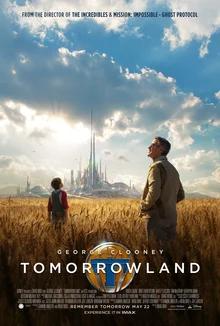
Tomorrowland
Optimistic teenager Casey Newton receives a mysterious pin that, when touched, drops her into a vision of Tomorrowland — a gleaming hidden city of impossible future technology. Tracking down the pin's origin leads her to Frank Walker, a disillusioned former boy-genius who was exiled from that city decades ago, and together they race to understand why humanity's brightest possible future has been sealed away and left to die.
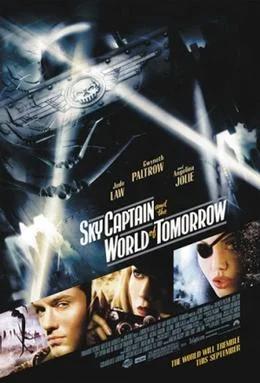
Sky Captain and the World of Tomorrow
1939, an alternate New York besieged by giant robots stomping through Manhattan. Mercenary pilot Joe 'Sky Captain' Sullivan and journalist Polly Perkins — his ex — race to uncover who is behind the attacks, chasing the trail across the globe to a hidden island fortress where a mad scientist's decades-old plan for 'the world of tomorrow' is finally coming to fruition.
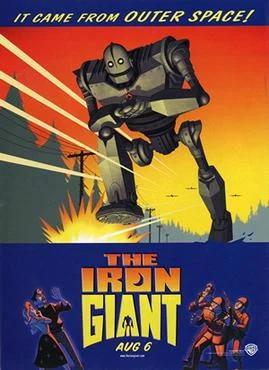
The Iron Giant
Maine, 1957. Young Hogarth Hughes discovers a colossal robot that fell from space, its memory wiped, hiding in the woods behind his house. As Hogarth teaches the Giant about the world — and about choice — a paranoid government agent closes in, convinced the visitor is a Cold War weapon that must be destroyed before it destroys them first.
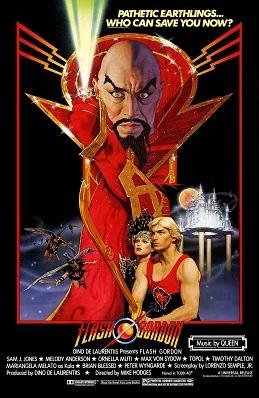
Flash Gordon
Football star Flash Gordon, travel agent Dale Arden and eccentric scientist Dr. Hans Zarkov are pulled through space to the planet Mongo, ruled by the tyrannical Ming the Merciless — who has set Earth in his crosshairs purely for sport. Flash must rally Mongo's warring kingdoms, the hawk-men of Sky City and the forest-dwelling Arboria, into a single rebellion before Ming's whim wipes out his home planet.
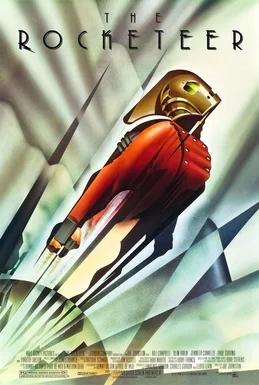
The Rocketeer
1938, Los Angeles. Stunt pilot Cliff Secord stumbles onto a prototype jetpack hidden in his hangar by gangsters — and straps it on. As word of a flying man spreads, Cliff finds himself hunted by Neville Sinclair, a matinee-idol movie star secretly working for Nazi agents desperate to recover the rocket before it reaches Germany, with only his mechanic Peevy and his girlfriend Jenny standing between the jetpack and the Third Reich.
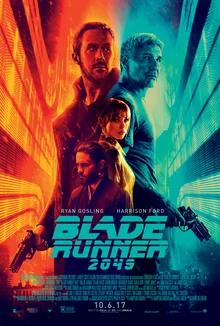
Blade Runner 2049
Thirty years after the original, K is a new-model replicant working as a blade runner for the LAPD, retiring older rogue models without complaint — until a routine job unearths a buried secret: evidence that a replicant once gave birth. The discovery could break the wall between the born and the built, and it sends K hunting for a child hidden decades ago, for a vanished blade runner named Deckard, and for an answer about himself he wants too badly to trust.
Comments
Sign in to join the conversation
No comments yet. Be the first!
Advertisement