Starship Troopers (1997)
TriStar Pictures· USA· 129 min· English
Directed by Paul VerhoevenMusic by Basil Poledouris
Synopsis
In a militarized future where citizenship must be earned through federal service, high school graduate Johnny Rico enlists in the Mobile Infantry alongside his friends, expecting glory. Instead, he finds himself on the front lines of an all-out interstellar war against the Arachnids, a species of massive, ravenous alien insects — while the propaganda broadcasts back home keep insisting humanity is winning.
Advertisement
Review
Paul Verhoeven's adaptation of Robert A. Heinlein's novel takes the source material's earnest, unapologetic militarism and inverts it entirely, building Starship Troopers as a satire so committed to its own recruitment-poster aesthetic that a significant portion of its original 1997 audience missed the joke completely, taking the film's surface-level heroics at face value. Every propaganda newsreel interstitial, every stiffly delivered recruitment-ad line reading, every impossibly clean-cut member of the young cast is doing precisely the same work RoboCop's fake television commercials did for Verhoeven a decade earlier — sincerity deployed as the actual delivery mechanism for the satire, rather than being the thing the satire is targeting.
Verhoeven has said plainly in interviews that he read only a handful of chapters of Heinlein's original novel before deciding it was, in his own words, boring and militaristic, and had the screenplay written from that point forward as a deliberate satirical response rather than any attempt at a faithful adaptation. Cast largely with actors who look like they stepped directly off an idealized recruitment poster — Casper Van Dien's jaw alone does a genuinely significant share of the film's ironic heavy lifting, having been cast specifically for his wholesome, all-American appearance — the film escalates its fascist visual iconography with an entirely straight face: the crisp uniforms, the mass rallies, the recurring "would you like to know more?" propaganda loop that interrupts the narrative at regular intervals. The newsreel-style interstitials were deliberately modeled on Leni Riefenstahl's Nazi propaganda filmmaking techniques, with Verhoeven, who grew up as a child in Nazi-occupied Rotterdam, drawing directly and knowingly on his own childhood memories of that specific visual language.
All of that satirical apparatus sits alongside genuinely massive, splatter-heavy alien-bug warfare that works perfectly well as pure spectacle even for viewers not consciously tracking the political satire running underneath it — individual close-up Arachnid creatures were built as detailed practical animatronics, while the massive swarms visible in wide battle shots relied on then-cutting-edge CGI, a hybrid effects approach Industrial Light & Magic had only recently refined a few years earlier on Jurassic Park. That dual functionality, action spectacle on the surface and pointed political satire underneath it, is exactly why the film was so consistently misread on release and has been so thoroughly reclaimed by serious critical reassessment in the decades since; Verhoeven has said the widespread misreading genuinely frustrated him at the time, even as it's since become a central part of the film's now-considerable cult reputation.
Denise Richards, playing star pilot Carmen Ibanez, gives the film one of its more quietly subversive touches: a competent, ambitious military officer who's simply good at her job within a militarized future society, treated by the narrative with the same straight-faced sincerity as her male castmates rather than as a token love interest waiting to be rescued. Basil Poledouris, who had scored RoboCop for Verhoeven a decade earlier, delivers a bombastic, unapologetically heroic military march that performs exactly the same ironic-sincerity function as the film's fake propaganda broadcasts — the music never winks at its own grandiosity, which is precisely why the satire surrounding it lands as hard as it does.
Beneath all the carnage and recruitment-poster sincerity, Verhoeven is making his most pointed political statement since RoboCop: a portrait of a society that has fully aestheticized militarism into consumable entertainment, so thoroughly and so seamlessly that its own citizens can no longer see the machine they're cheering for from the inside. It's a brutal, frequently very funny film, deliberately shallow exactly where shallowness serves the joke and completely serious exactly where it counts, and it remains one of the most persistently misunderstood studio blockbusters of its entire decade — a film that dared its audience to enjoy fascist spectacle and then quietly asked, mid-cheer, whether they'd noticed what they were actually applauding.
The two-decade critical reassessment the film has undergone since 1997 says something notable about how satire ages: what read to some contemporary audiences as simple, gung-ho action spectacle has become, with hindsight and cultural distance, one of the more frequently cited examples of a studio blockbuster smuggling genuine political argument past its own marketing department. Few films have needed this much time to be properly understood, and fewer still have rewarded the wait as completely.
The Arachnid "Bugs" themselves — massive insectoid creatures organized into specialized warrior, brain and plasma-launching castes, coordinating attacks across interstellar distances — draw loosely on real eusocial insect biology, ants and termites in particular, scaled up to a size no known arthropod exoskeleton could plausibly support under Earth-like gravity. But biological plausibility was never really the point; the film's actual target is a still-relevant satire of how societies package militarism as heroic, consumable entertainment, built from propaganda-newsreel techniques lifted with real specificity from actual historical fascist media rather than invented wholesale for the screen.
Trivia & Color Notes
Verhoeven never finished the book
Paul Verhoeven has said he read only a few chapters of Heinlein's original novel before deciding it was 'boring' and 'militaristic,' and had the screenplay written as a deliberate satirical response rather than a faithful adaptation.
Propaganda broadcasts, built from real history
The film's newsreel-style interstitials were deliberately modeled on Leni Riefenstahl's Nazi propaganda filmmaking techniques, with Verhoeven — who grew up in Nazi-occupied Rotterdam — drawing directly on his own childhood memories of that visual language.
Widely misunderstood at release
Many 1997 critics and audiences took the film's militarism at face value rather than as satire, a misreading Verhoeven has said frustrated him — critical reassessment over the following two decades has substantially reversed the film's reputation.
Practical bugs, digital swarms
Individual close-up Arachnid creatures were built as practical animatronics, while the massive swarms seen in wide battle shots used then-cutting-edge CGI — a hybrid approach ILM had refined only a few years earlier on Jurassic Park.
The Arachnid "Bugs" — massive insectoid creatures with specialized warrior, brain, and plasma-launching castes, coordinating across interstellar distances — draw loosely on real eusocial insect biology (ants, termites) scaled up implausibly, since no known biology could support arthropod exoskeletons at that mass under Earth-like gravity. The film's real target isn't biological plausibility, though — it's a pointed, still-relevant satire of how societies package militarism as heroic entertainment, using genuinely well-observed propaganda-newsreel techniques lifted directly from real historical fascist media.
🎵 Soundtrack
Music by Basil Poledouris
Basil Poledouris, who scored RoboCop for Verhoeven a decade earlier, delivers a bombastic, unapologetically heroic military march — deliberately straight-faced and rousing, doing exactly the same ironic-sincerity work as the film's fake propaganda broadcasts.
🔗 This film connects to…
Cast & Crew
Advertisement
You Might Also Like
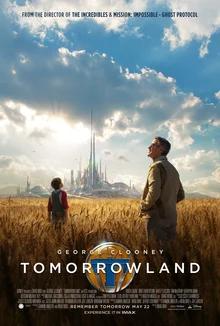
Tomorrowland
Optimistic teenager Casey Newton receives a mysterious pin that, when touched, drops her into a vision of Tomorrowland — a gleaming hidden city of impossible future technology. Tracking down the pin's origin leads her to Frank Walker, a disillusioned former boy-genius who was exiled from that city decades ago, and together they race to understand why humanity's brightest possible future has been sealed away and left to die.
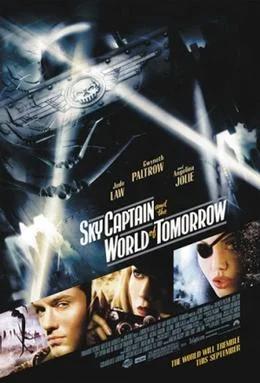
Sky Captain and the World of Tomorrow
1939, an alternate New York besieged by giant robots stomping through Manhattan. Mercenary pilot Joe 'Sky Captain' Sullivan and journalist Polly Perkins — his ex — race to uncover who is behind the attacks, chasing the trail across the globe to a hidden island fortress where a mad scientist's decades-old plan for 'the world of tomorrow' is finally coming to fruition.
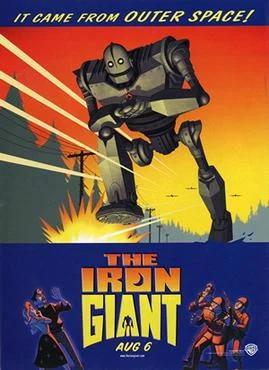
The Iron Giant
Maine, 1957. Young Hogarth Hughes discovers a colossal robot that fell from space, its memory wiped, hiding in the woods behind his house. As Hogarth teaches the Giant about the world — and about choice — a paranoid government agent closes in, convinced the visitor is a Cold War weapon that must be destroyed before it destroys them first.
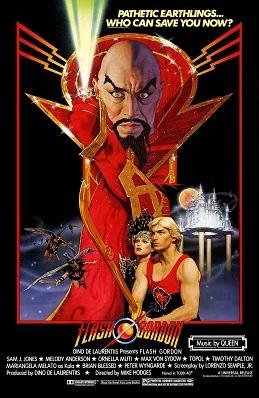
Flash Gordon
Football star Flash Gordon, travel agent Dale Arden and eccentric scientist Dr. Hans Zarkov are pulled through space to the planet Mongo, ruled by the tyrannical Ming the Merciless — who has set Earth in his crosshairs purely for sport. Flash must rally Mongo's warring kingdoms, the hawk-men of Sky City and the forest-dwelling Arboria, into a single rebellion before Ming's whim wipes out his home planet.
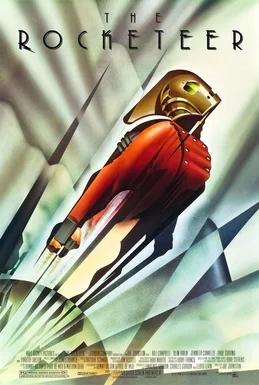
The Rocketeer
1938, Los Angeles. Stunt pilot Cliff Secord stumbles onto a prototype jetpack hidden in his hangar by gangsters — and straps it on. As word of a flying man spreads, Cliff finds himself hunted by Neville Sinclair, a matinee-idol movie star secretly working for Nazi agents desperate to recover the rocket before it reaches Germany, with only his mechanic Peevy and his girlfriend Jenny standing between the jetpack and the Third Reich.
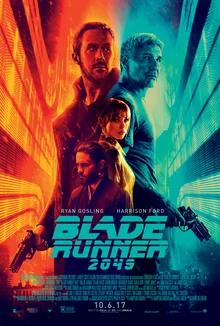
Blade Runner 2049
Thirty years after the original, K is a new-model replicant working as a blade runner for the LAPD, retiring older rogue models without complaint — until a routine job unearths a buried secret: evidence that a replicant once gave birth. The discovery could break the wall between the born and the built, and it sends K hunting for a child hidden decades ago, for a vanished blade runner named Deckard, and for an answer about himself he wants too badly to trust.
Comments
Sign in to join the conversation
No comments yet. Be the first!
Advertisement