Total Recall (1990)
TriStar Pictures· USA· 113 min· English
Directed by Paul VerhoevenMusic by Jerry Goldsmith
Synopsis
Construction worker Doug Quaid can't stop dreaming of Mars, so he buys the memory of a trip from Rekall Inc. — and the implant chair wakes something already buried in his head. Soon he's killing trained agents by reflex, and the only certainty is a message from his own face: get your ass to Mars.
Advertisement
Review
Total Recall took sixteen years and something in the neighborhood of forty screenplay drafts to actually reach a screen, cycling through multiple attached directors and at least one studio bankruptcy along the way, before Arnold Schwarzenegger personally intervened, convinced the financing company Carolco to purchase the rights outright, and then hand-picked Paul Verhoeven to direct after being impressed by what RoboCop had managed to smuggle past studio notes a few years earlier. What eventually reached theaters is, at bottom, the most expensive Philip K. Dick anxiety attack ever financed by a major studio — Verhoeven takes Dick's short story "We Can Remember It for You Wholesale" and runs it directly through the same satirical, ultraviolent machine that had already served RoboCop so well: maximum squibs, maximum media satire, and a genuine philosophical trapdoor hidden underneath nearly every action beat.
That trapdoor is the reason the film has aged into something closer to a cult puzzle box than a straightforward action vehicle. Is Doug Quaid a secret agent whose memory was surgically erased and buried under a fabricated identity, exactly as the plot's espionage machinery suggests? Or is he simply a Rekall customer whose paid-for memory implant has malfunctioned, trapping him inside an elaborate power fantasy of his own making while his actual body lies motionless in a chair back on Earth? Verhoeven has said in interviews that he deliberately engineered the film so that both readings remain fully consistent with the evidence all the way to the ambiguous white flash that closes it, and it's a genuinely rare thing for a mainstream studio blockbuster to build an unresolvable reality problem directly into its structure rather than settling the question for the sake of audience comfort.
As pure physical spectacle, the film stands as one of the last great monuments to practical effects work before digital tools began taking over the genre in earnest. Rob Bottin, already responsible for some of the most extraordinary creature work of the previous decade, built the three-breasted Martian mutant, the bulging-eyed victims of Mars's thin atmosphere, and — in the film's most purely delightful single gag — a disguise that allows Quaid to pass through customs as an overweight woman, right up until the mechanism visibly malfunctions and the disguise begins disassembling itself in the middle of a crowded checkpoint while it keeps delivering its scripted dialogue. Bottin reportedly built that specific effect using more than a hundred separate servo-driven movements, a staggering amount of engineering for a joke that lasts less than a minute on screen. The miniature Mars sets and colony work earned the production a Special Achievement Academy Award, and Verhoeven's characteristically gleeful approach to the violence — never gratuitous for its own sake so much as pointedly excessive, in keeping with his broader satirical style — keeps the film's paranoid atmosphere weighted with real physical consequence rather than drifting into weightless spectacle.
What holds the whole apparatus together is a performance from Schwarzenegger that rarely gets the credit it deserves for its specific difficulty. Quaid spends most of the film in a state of genuine, disorienting confusion about his own identity, and Schwarzenegger — an actor more typically celebrated for physical command than psychological nuance — plays that confusion with real conviction, selling the idea of a man whose muscles and reflexes seem to remember a life his conscious mind has no access to. The film's action beats work precisely because of this tension: Quaid disarms trained killers with an ease that visibly startles him as much as it does his attackers, a performance choice that keeps the audience unsure, right alongside the character, whether they're watching a hero's true nature reasserting itself or a fantasy indulging its own wish fulfillment a little too smoothly.
Around him, Sharon Stone's turn as Quaid's supposed wife Lori remains one of the sharpest reversals in the genre — a domestic partner who reveals herself to be a trained operative planted specifically to monitor and, if necessary, eliminate him, delivering "consider that a divorce" moments before trying to kill him with a level of icy composure that makes the earlier scenes of ordinary marital bickering retroactively unsettling on a rewatch. The film's Martian tyrant Cohaagen, meanwhile, running the colony's air supply as a metered utility that can be shut off to punish dissent, gives Total Recall's satire its sharpest edge: a society where breathing itself has been successfully privatized isn't much of an exaggeration of the logic Verhoeven had already skewered once in RoboCop, just relocated to a setting where the stakes are literally the air in your lungs.
What ultimately separates Total Recall from the glut of interchangeable science fiction action vehicles the era also produced is how deliberately it refuses to let its audience settle into either genre comfort or philosophical certainty. It delivers all the pleasures of a big, loud, gleefully over-the-top Schwarzenegger action picture while quietly insisting, underneath all of it, that the hero's entire reality might be a product he purchased and can't actually trust. Few films have managed that particular double game as successfully, and fewer still have made the ambiguity feel like the entire point rather than an unresolved loose thread.
Jerry Goldsmith's score, one he reportedly considered among the finest work of his own long career, gives the Martian sequences a pounding, percussive momentum with electronic edges bridging his earlier atmospheric work on Alien and the more muscular action scoring that would dominate the following decade. That musical confidence matches the film's own: this is a production that never once apologizes for how far-fetched its premise is, choosing instead to lean all the way into the pulp logic of a Mars-sized reactor melting a planetary core into breathable air within minutes, because the emotional and thematic questions underneath the spectacle matter more to Verhoeven than any of the hand-waved mechanics ever could. Watching it again decades later, in an era considerably more comfortable with unreliable narrators and ambiguous endings than 1990 mainstream audiences were, it plays less like a curiosity from action cinema's past and more like a film that was simply built for a more skeptical audience than the one that first paid to see it.
Trivia & Color Notes
Your eyes would not pop
Explosive decompression on Mars is movie myth: real vacuum exposure causes unconsciousness in ~15 seconds and death in minutes, but no bursting. NASA's actual 1966 vacuum-chamber accident victim woke up fine — his last memory was the saliva boiling on his tongue.
Bottin's mutant workshop
Rob Bottin built Kuato, the three-breasted Mary, and Quaid's malfunctioning fat-lady disguise as full animatronics. The disguise head — splitting into segments while delivering a one-liner — used 107 separate servo movements.
Is it all a dream? Officially: yes and no
Verhoeven constructed the film so both readings work — and points to the white fade-out as the moment Quaid may be lobotomized inside his Rekall fantasy. Schwarzenegger prefers the 'it's real' reading. The screenwriters refuse to vote.
Johnnycab
The robotic taxi driver — cheerful, useless, flammable — was a fully practical animatronic. Its passive-aggressive customer service ('The fare is 18 credits, please') predicted every voice assistant you've ever shouted at.
Arnold saved it from development hell
The script burned through ~40 drafts, multiple directors and a bankrupt studio over 16 years. Schwarzenegger convinced Carolco to buy the rights, then hand-picked Verhoeven after seeing RoboCop.
Memory implantation as retail service remains fiction, though targeted memory manipulation in mice (optogenetics) has made the question less absurd than in 1990. The film's worst physics is its most famous scene: humans don't burst or boil instantly in Mars's thin atmosphere — you'd lose consciousness in under a minute, no eye-popping required. Its best idea holds up brilliantly: a colony where the oxygen supply is privatized is just infrastructure economics with the mask off. The turbinium reactor melting a planet's core into breathable air in minutes — pure opera.
🎵 Soundtrack
Music by Jerry Goldsmith
Jerry Goldsmith considered this among his own best scores: a pounding, percussive Mars march with electronic edges — the bridge between his Alien atmospherics and modern action scoring.
🔗 This film connects to…
Cast & Crew
Advertisement
You Might Also Like
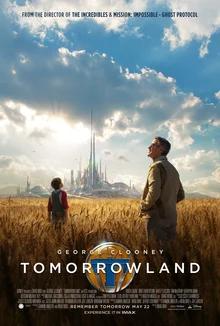
Tomorrowland
Optimistic teenager Casey Newton receives a mysterious pin that, when touched, drops her into a vision of Tomorrowland — a gleaming hidden city of impossible future technology. Tracking down the pin's origin leads her to Frank Walker, a disillusioned former boy-genius who was exiled from that city decades ago, and together they race to understand why humanity's brightest possible future has been sealed away and left to die.
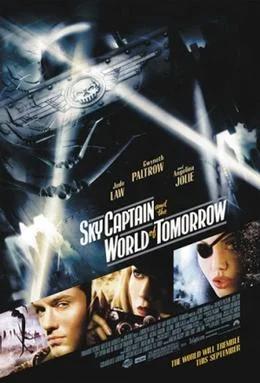
Sky Captain and the World of Tomorrow
1939, an alternate New York besieged by giant robots stomping through Manhattan. Mercenary pilot Joe 'Sky Captain' Sullivan and journalist Polly Perkins — his ex — race to uncover who is behind the attacks, chasing the trail across the globe to a hidden island fortress where a mad scientist's decades-old plan for 'the world of tomorrow' is finally coming to fruition.
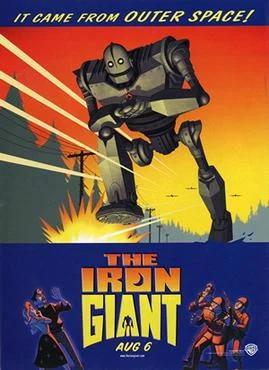
The Iron Giant
Maine, 1957. Young Hogarth Hughes discovers a colossal robot that fell from space, its memory wiped, hiding in the woods behind his house. As Hogarth teaches the Giant about the world — and about choice — a paranoid government agent closes in, convinced the visitor is a Cold War weapon that must be destroyed before it destroys them first.
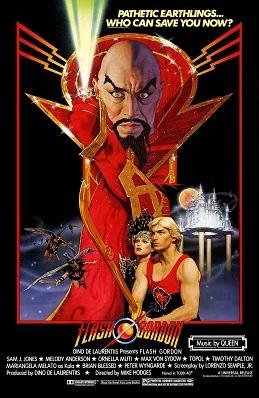
Flash Gordon
Football star Flash Gordon, travel agent Dale Arden and eccentric scientist Dr. Hans Zarkov are pulled through space to the planet Mongo, ruled by the tyrannical Ming the Merciless — who has set Earth in his crosshairs purely for sport. Flash must rally Mongo's warring kingdoms, the hawk-men of Sky City and the forest-dwelling Arboria, into a single rebellion before Ming's whim wipes out his home planet.
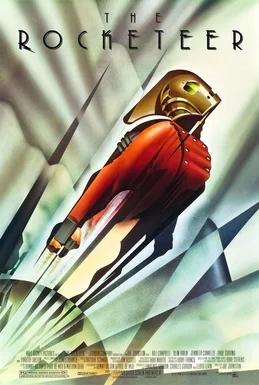
The Rocketeer
1938, Los Angeles. Stunt pilot Cliff Secord stumbles onto a prototype jetpack hidden in his hangar by gangsters — and straps it on. As word of a flying man spreads, Cliff finds himself hunted by Neville Sinclair, a matinee-idol movie star secretly working for Nazi agents desperate to recover the rocket before it reaches Germany, with only his mechanic Peevy and his girlfriend Jenny standing between the jetpack and the Third Reich.
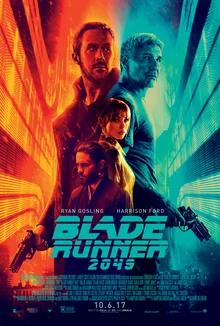
Blade Runner 2049
Thirty years after the original, K is a new-model replicant working as a blade runner for the LAPD, retiring older rogue models without complaint — until a routine job unearths a buried secret: evidence that a replicant once gave birth. The discovery could break the wall between the born and the built, and it sends K hunting for a child hidden decades ago, for a vanished blade runner named Deckard, and for an answer about himself he wants too badly to trust.
Comments
Sign in to join the conversation
No comments yet. Be the first!
Advertisement