Strange Days (1995)
20th Century Fox· USA· 145 min· English
Directed by Kathryn BigelowMusic by Graeme Revell
Synopsis
Los Angeles, the last two days of 1999. Lenny Nero, ex-cop turned black-market dealer, sells SQUID recordings — full sensory captures of other people's experiences, straight from their cerebral cortex to yours. Addicted to replaying tapes of his own lost relationship, Lenny is dragged out of his loop when a snuff recording lands in his hands: evidence of a murder that connects to his ex, a music-industry conspiracy, and a police killing that could set the burning city off entirely.
Advertisement
Review
Conceived years earlier and co-written by James Cameron, then directed by Kathryn Bigelow, Strange Days stands as cyberpunk's great film about media itself, rather than about hackers, corporations or cyborgs directly — the recorded texture of another person's human experience treated as a genuine drug, sold discreetly in back rooms to users who have come to prefer replaying someone else's life to living their own. The SQUID device is arguably the single sharpest conceptual invention the genre produced across the entire decade: playback through the rig isn't watching a recording, it's fully being the person who originally lived it, sensation for sensation, and Bigelow shoots the resulting clips as unbroken, technically dazzling first-person single takes that remain genuinely disorienting to watch, morally queasy in precisely the way she clearly intends them to be.
Ralph Fiennes's Lenny Nero makes an ideal dealer-protagonist for that premise — a nostalgia junkie hopelessly hooked on his own product, endlessly replaying tapes of a dead relationship while the rest of Los Angeles counts down toward an anxious millennium midnight around him. Fiennes, fresh off an Academy Award nomination for his chilling work in Schindler's List, deliberately sought out a role that would let him work in a considerably more physically unraveled, less controlled register than that earlier performance, and the choice pays off in a portrait of addiction that never once slides into simple pity.
But the film's actual conscience, and its real hero, is Angela Bassett's Mace, a professional bodyguard who refuses the SQUID wire entirely on principle, having watched what the technology has done to everyone around her who's tried it. Already an Academy Award nominee for her performance as Tina Turner in What's Love Got to Do with It, Bassett brings a fierce, physically grounded conviction to Mace that gives the film its actual moral architecture: somebody in this story has to remain fully present in unrecorded, unmediated reality, or there's nobody left with the clarity to act when it genuinely matters.
The film's most technically demanding sequences — a single-shot robbery-and-rooftop-fall sequence that opens the film, taking dozens of takes to execute using custom-built, unusually lightweight camera rigs — remain landmark achievements in first-person point-of-view cinematography that few subsequent films have matched for sheer sustained technical control. Graeme Revell's industrial-tinged score shares space with one of the decade's great soundtrack curations, featuring PJ Harvey, Tricky and Juliette Lewis performing her own songs live on screen, capturing the exact anxious, decadent sound of the millennium's final party running down its last hours.
What makes the film land considerably harder now than it did in 1995, when it flopped badly at the box office against a reported budget of roughly $42 million, is its central plot engine: the police killing of a Black musician, captured entirely on a recording that the political establishment desperately wants buried and that could, if released, ignite a city already on edge. Shot in a Los Angeles still visibly processing the trauma of 1992, the film asks a genuinely hard question — what happens once atrocity can be recorded from inside the victim's own skin, indistinguishable from lived experience rather than distant footage — and treats that question with real seriousness rather than as simple exploitation.
Decades of subsequent viral bystander and bodycam footage later, that question has stopped being hypothetical in any sense at all, and Strange Days has completed its long journey from expensive, poorly received flop to essential, frequently rediscovered genre text, one whose sharpest insight — that recorded experience can function simultaneously as escapist drug and as irrefutable evidence of state violence — arrived roughly fifteen years ahead of the smartphone era that would make the same tension a daily, unavoidable fact of public life.
The SQUID rig itself borrows its name from a real piece of technology — superconducting quantum interference devices genuinely exist and are used to measure the brain's own magnetic fields with real scientific precision — but the film leaps from that crude, legitimate measurement capability directly to full-fidelity recording and playback of subjective experience, a jump that remains far beyond anything actual neuroscience can currently support. As a piece of media sociology rather than hard science, though, the film is startlingly predictive: experience captured entirely first-person, traded on a black market, consumed purely as escapism, and finally functioning as irrefutable evidence of state violence maps almost precisely onto the smartphone-and-bodycam era that would actually arrive roughly fifteen years later.
Bigelow's own directorial signature, a kinetic, tactile camera style she'd go on to refine further in later acclaimed work, is visible throughout in how physically grounded even the film's most disorienting first-person sequences feel; nothing here reads as abstract spectacle, every recorded experience carries the specific weight of a real body moving through a real, dangerous space.
Trivia & Color Notes
First-person, for real
The film's SQUID playback sequences were shot as genuine unbroken first-person takes using custom-built lightweight camera rigs — including a single-shot robbery-and-rooftop-fall opening that took dozens of takes and remains a landmark of POV cinematography.
Cameron wrote it, Bigelow made it hers
James Cameron conceived the story years earlier and wrote the script treatment during the Terminator 2 era; his ex-wife Kathryn Bigelow directed. The pairing gives the film Cameron's structural engine with Bigelow's rawer, more tactile street-level style.
A real acronym, borrowed
SQUID — superconducting quantum interference device — is genuine physics: real SQUIDs measure magnetic fields including the brain's. The film borrowed the acronym and upgraded the capability from crude measurement to full experience recording.
From flop to canon
Made for roughly $42M, the film earned back a fraction of that in theaters — one of 1995's biggest bombs. Critical reassessment, especially of its police-violence storyline, has since elevated it to essential-cyberpunk status.
The SQUID rig borrows its name from a real technology — superconducting quantum interference devices genuinely exist and can measure the brain's magnetic fields — but leaps from crude measurement to full-fidelity recording and playback of subjective experience, which remains far beyond neuroscience. As media sociology, though, the film is startlingly predictive: experience captured first-person, traded, consumed as escapism, and finally functioning as evidence of state violence maps almost one-to-one onto the smartphone-and-bodycam era that arrived fifteen years later.
🎵 Soundtrack
Music by Graeme Revell
Graeme Revell's industrial-tinged score shares space with one of the era's great soundtrack curations — PJ Harvey, Tricky, and Juliette Lewis performing her own songs live on screen — capturing the exact sound of the millennium's final anxious party.
🔗 This film connects to…
Cast & Crew
Director
Writer
Producer
Composer
Cast
- Ralph Fiennes as Lenny Nero
- Angela Bassett as Lornette 'Mace' Mason
Advertisement
You Might Also Like
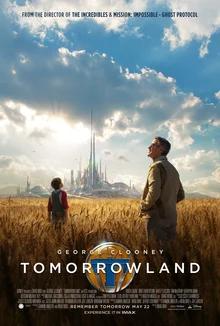
Tomorrowland
Optimistic teenager Casey Newton receives a mysterious pin that, when touched, drops her into a vision of Tomorrowland — a gleaming hidden city of impossible future technology. Tracking down the pin's origin leads her to Frank Walker, a disillusioned former boy-genius who was exiled from that city decades ago, and together they race to understand why humanity's brightest possible future has been sealed away and left to die.
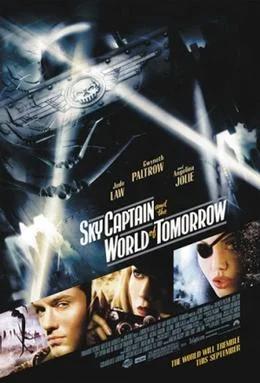
Sky Captain and the World of Tomorrow
1939, an alternate New York besieged by giant robots stomping through Manhattan. Mercenary pilot Joe 'Sky Captain' Sullivan and journalist Polly Perkins — his ex — race to uncover who is behind the attacks, chasing the trail across the globe to a hidden island fortress where a mad scientist's decades-old plan for 'the world of tomorrow' is finally coming to fruition.
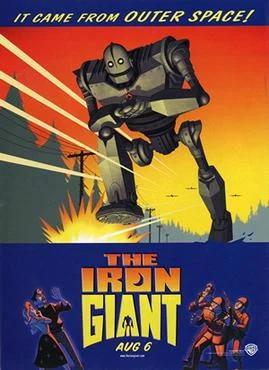
The Iron Giant
Maine, 1957. Young Hogarth Hughes discovers a colossal robot that fell from space, its memory wiped, hiding in the woods behind his house. As Hogarth teaches the Giant about the world — and about choice — a paranoid government agent closes in, convinced the visitor is a Cold War weapon that must be destroyed before it destroys them first.
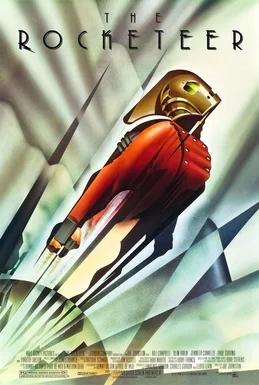
The Rocketeer
1938, Los Angeles. Stunt pilot Cliff Secord stumbles onto a prototype jetpack hidden in his hangar by gangsters — and straps it on. As word of a flying man spreads, Cliff finds himself hunted by Neville Sinclair, a matinee-idol movie star secretly working for Nazi agents desperate to recover the rocket before it reaches Germany, with only his mechanic Peevy and his girlfriend Jenny standing between the jetpack and the Third Reich.
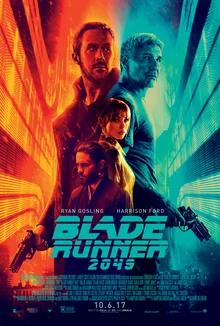
Blade Runner 2049
Thirty years after the original, K is a new-model replicant working as a blade runner for the LAPD, retiring older rogue models without complaint — until a routine job unearths a buried secret: evidence that a replicant once gave birth. The discovery could break the wall between the born and the built, and it sends K hunting for a child hidden decades ago, for a vanished blade runner named Deckard, and for an answer about himself he wants too badly to trust.
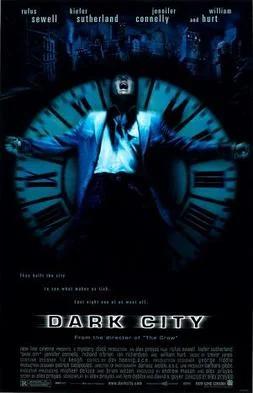
Dark City
John Murdoch wakes in a hotel bathtub with no memory, a dead woman in the next room, and detectives closing in for murders he can't remember committing. As he runs through a city where it is always midnight, he begins noticing what no one else does: at 12:00 exactly, the entire population falls asleep, the buildings physically rearrange themselves — and pale men in long coats move among the sleepers, injecting new memories into new lives.
Comments
Sign in to join the conversation
No comments yet. Be the first!
Advertisement