Twelve Monkeys (1995)
12 Monkeys
Universal Pictures· USA· 129 min· English
Directed by Terry Gilliam
Synopsis
In 2035, decades after a virus killed five billion people and drove the survivors underground, prisoner James Cole is sent back in time — not to prevent the outbreak, which is impossible, but to trace its source. Battered between decades and diagnosed insane in 1990, Cole begins to wonder if the doctors are right, while a childhood memory of an airport shooting keeps circling closer.
Advertisement
Review
Twelve Monkeys takes its central premise from Chris Marker's La Jetée, a twenty-eight-minute French film from 1962 told almost entirely through still photographs, and expands that haunting, spare short into what remains one of the most rigorously fatalistic time-travel stories Hollywood has ever financed. Gilliam reportedly refused to rewatch Marker's original during production, worried that direct exposure would tempt him into simple imitation rather than genuine adaptation, and the resulting film stands entirely on its own while honoring its source's bleakest idea: the future cannot be changed. It can only be observed, catalogued, understood after the fact. James Cole isn't sent back in time to prevent the pandemic that's already killed five billion people and driven survivors underground — that mission is explicitly stated to be impossible from the outset. He's sent back to trace the outbreak's origin, to gather a sample, to bring back information rather than a solution. That single structural choice inverts the entire logic of the genre: Cole isn't racing against a clock to stop an apocalypse. He's racing to witness it accurately, and the film's tragedy tightens with the patience of a ratchet toward an airport scene we've technically already glimpsed, in fragments, from the opening minutes.
Gilliam's signature visual clutter — analog machinery, cracked tile, wheezing pipework, interrogation devices assembled from junked televisions — has arguably never served a story this well anywhere else in his filmography. The underground 2035 he builds looks less like an imagined future than like the accumulated basement of the entire twentieth century, every obsolete technology still down there, still running on fumes because nobody had the resources to replace it with anything better. The time-travel apparatus itself, a chaotic tangle of wiring and monitors that scientists in hazmat suits operate with visible uncertainty, reads like something that might genuinely misfire and strand you in the wrong decade entirely, which is more or less exactly what happens to Cole more than once.
Bruce Willis, cast deliberately against every expectation his action-hero career had built up to that point, gives what remains arguably the most vulnerable performance of his entire filmography. Gilliam has said he gave Willis a literal written list of "Willis acting clichés" that were banned from the production — the knowing smirk, the steely blue-eyed stare that had anchored a decade of action vehicles — and Willis, reportedly taking a significantly reduced fee for the privilege of the role, delivers Cole instead as a man coming genuinely undone, someone who weeps openly at Fats Domino playing on a car radio because he's hearing, for what might be the only time in his life, the ordinary, unremarkable texture of a century he was never meant to survive long enough to appreciate. Opposite him, Brad Pitt's performance as institutionalized revolutionary Jeffrey Goines is a genuinely different kind of transformation: reportedly spending weeks observing patients in a psychiatric ward's day room as research, and having his own cigarette access deliberately rationed by the production to keep him visibly agitated and twitchy on camera, Pitt won a Golden Globe and earned his first Academy Award nomination for a performance built almost entirely out of nervous tics, sudden verbal tangents and unsettling, unpredictable eye contact.
The film's deepest and most quietly brilliant trick, though, is epistemological rather than purely emotional. For the majority of the runtime, two competing explanations for everything Cole experiences remain equally well supported by the available evidence: either he is genuinely a time traveler from a devastated future, dispatched on an impossible mission, or he is a man suffering a severe psychiatric break who has constructed an elaborate, internally consistent delusion to explain his own confusion and trauma. The film refuses to tip its hand toward either reading for most of its length, and psychiatrist Dr. Kathryn Railly, played by Madeleine Stowe, functions as the audience's proxy in that uncertainty — she keeps switching sides herself, professionally convinced one moment that her patient is delusional and unsettled the next by evidence that seems to confirm exactly what he's been telling her all along.
Paul Buckmaster's score threads Astor Piazzolla's "Suite Punta del Este" through the film like a recurring, lurching, carnival-sad tango, a piece of music that sounds simultaneously festive and mournful in exactly the register the story needs, and its reappearance at key moments functions almost as the film's own fatalistic heartbeat, reminding the audience gently that everything unfolding has, in some sense, already happened before and will happen again exactly the same way.
When the loop finally closes, in the film's final minutes, it closes not on an explanation or a twist delivered through dialogue but on a child's eyes, widening in recognition at an airport we've now seen play out to its full, devastating conclusion. Very few American studio films have ever been allowed to end on a note this bleak, this patiently constructed, or this genuinely tragic — the boy at the gate, watching, beginning to understand what he's just witnessed, condemned by the film's own iron logic to grow up, forget nothing, and eventually become the man we've spent the entire runtime following back to this exact moment.
Gilliam built his ravaged 2035 largely inside decommissioned power stations in Philadelphia and Baltimore, dressing over the existing industrial architecture with junked, obsolete equipment rather than constructing an imagined future from scratch, and the interrogation sphere of stacked, humming televisions that surrounds Cole during his early debriefings drew inspiration directly from Philadelphia's abandoned Eastern State Penitentiary, a real decaying structure the production toured during scouting. That commitment to grounding an apocalyptic future in genuinely rotting, physically existing places gives the film a tactile bleakness that a more digitally constructed vision of the same story would likely have sacrificed. Nearly three decades later, having become an unlikely rewatch phenomenon during the early days of a real global pandemic, the film's portrait of institutional indifference, engineered outbreaks and a population too fractured to agree on basic reality has only grown more uncomfortable to sit with, which is precisely the kind of endurance a genuinely serious piece of science fiction is supposed to earn.
Trivia & Color Notes
Born from a 28-minute film of photographs
The film is 'inspired by' Chris Marker's La Jetée (1962), told almost entirely in still images — including the core image of a child witnessing his own future death at an airport. Gilliam refused to watch it during production to avoid imitation.
Willis's forbidden list
Gilliam gave Bruce Willis a written list of 'Willis acting clichés' banned from the film — including the smirk and the steely-blue-eyes stare. Willis took a fraction of his fee to do it.
Pitt couldn't stop blinking
To play Goines, Brad Pitt spent weeks in a psychiatric ward's day room and reportedly had his cigarettes rationed to keep him twitchy. The performance earned him a Golden Globe and his first Oscar nomination.
The unchangeable past
Cole's mission obeys the Novikov self-consistency principle: time travelers can't alter history because their actions were always part of it. The film is one of the very few to commit to this bleak logic completely — no branching timelines, no take-backs.
Futures built from ruins
Gilliam built 2035 inside decommissioned power stations in Philadelphia and Baltimore, dressing turbine halls with junked technology. The 'interrogation sphere' of stacked TVs was inspired by Philly's abandoned Eastern State Penitentiary.
The film's time-travel model is the rigorously self-consistent kind: the past cannot be altered, cause and effect form a closed loop, and every attempt to intervene is already part of history — the 'Novikov self-consistency principle' physicists actually discuss. Its pandemic science is grimly reasonable (engineered virus, patient-zero spread via air travel; the film became a rewatch phenomenon in 2020), and its portrait of institutional psychiatry — where a true statement is untreatable — draws real epistemology. The sending mechanism itself is, as always, a glowing machine.
🎵 Soundtrack
Paul Buckmaster's score orbits Astor Piazzolla's 'Suite Punta del Este' — a lurching, carnival-sad tango that is the film's fatalism in musical form. Louis Armstrong's 'What a Wonderful World' over the ending is Gilliam twisting the knife gently.
🔗 This film connects to…
Cast & Crew
Director
Cast
- Bruce Willis as James Cole
- Brad Pitt as Jeffrey Goines
Advertisement
You Might Also Like
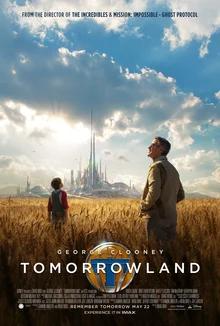
Tomorrowland
Optimistic teenager Casey Newton receives a mysterious pin that, when touched, drops her into a vision of Tomorrowland — a gleaming hidden city of impossible future technology. Tracking down the pin's origin leads her to Frank Walker, a disillusioned former boy-genius who was exiled from that city decades ago, and together they race to understand why humanity's brightest possible future has been sealed away and left to die.
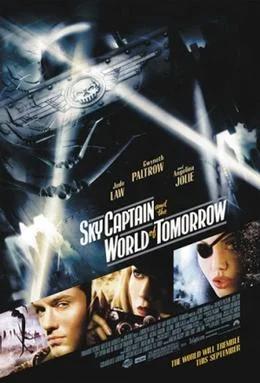
Sky Captain and the World of Tomorrow
1939, an alternate New York besieged by giant robots stomping through Manhattan. Mercenary pilot Joe 'Sky Captain' Sullivan and journalist Polly Perkins — his ex — race to uncover who is behind the attacks, chasing the trail across the globe to a hidden island fortress where a mad scientist's decades-old plan for 'the world of tomorrow' is finally coming to fruition.
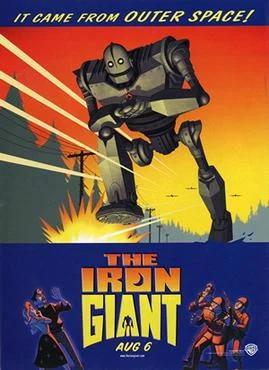
The Iron Giant
Maine, 1957. Young Hogarth Hughes discovers a colossal robot that fell from space, its memory wiped, hiding in the woods behind his house. As Hogarth teaches the Giant about the world — and about choice — a paranoid government agent closes in, convinced the visitor is a Cold War weapon that must be destroyed before it destroys them first.
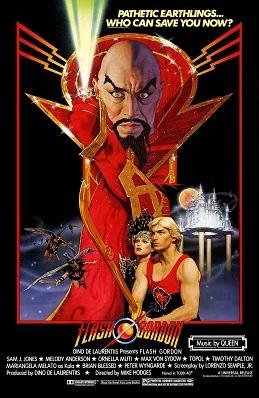
Flash Gordon
Football star Flash Gordon, travel agent Dale Arden and eccentric scientist Dr. Hans Zarkov are pulled through space to the planet Mongo, ruled by the tyrannical Ming the Merciless — who has set Earth in his crosshairs purely for sport. Flash must rally Mongo's warring kingdoms, the hawk-men of Sky City and the forest-dwelling Arboria, into a single rebellion before Ming's whim wipes out his home planet.
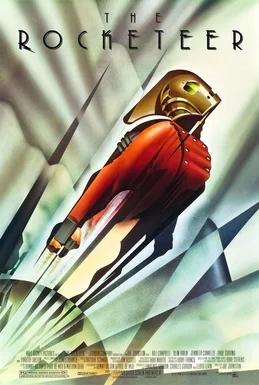
The Rocketeer
1938, Los Angeles. Stunt pilot Cliff Secord stumbles onto a prototype jetpack hidden in his hangar by gangsters — and straps it on. As word of a flying man spreads, Cliff finds himself hunted by Neville Sinclair, a matinee-idol movie star secretly working for Nazi agents desperate to recover the rocket before it reaches Germany, with only his mechanic Peevy and his girlfriend Jenny standing between the jetpack and the Third Reich.
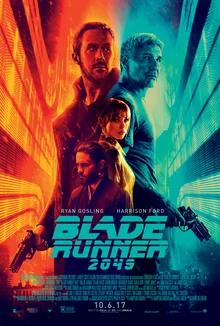
Blade Runner 2049
Thirty years after the original, K is a new-model replicant working as a blade runner for the LAPD, retiring older rogue models without complaint — until a routine job unearths a buried secret: evidence that a replicant once gave birth. The discovery could break the wall between the born and the built, and it sends K hunting for a child hidden decades ago, for a vanished blade runner named Deckard, and for an answer about himself he wants too badly to trust.
Comments
Sign in to join the conversation
No comments yet. Be the first!
Advertisement