Back to the Future (1985)
Universal Pictures· USA· 116 min· English
Directed by Robert ZemeckisMusic by Alan SilvestriCinematography by Dean Cundey
Synopsis
Teenager Marty McFly is accidentally blasted from 1985 to 1955 in a time machine his friend Doc Brown built out of a DeLorean. Stranded with no plutonium, he derails his own parents' first meeting — and has one week to make his father fall in love with his mother, or he'll never be born.
Advertisement
Review
Robert Zemeckis and Bob Gale reportedly spent years shopping the script for Back to the Future around Hollywood before anyone would finance it, collecting rejections from studios who found the premise either too tame for a teen comedy or too strange for a family film, depending on which executive was reading it that week. It's one of the more instructive footnotes in the film's history, because the finished product is now routinely cited, in screenwriting classes and film-school syllabi alike, as one of the most structurally airtight scripts the studio system has ever produced — a machine with essentially no wasted parts, in which nearly every joke, object and line of dialogue planted in the 1985 opening act returns with a mechanically precise payoff once the story lands in 1955. Marty's Walkman terrifies his own future father as an alien device. A photograph of his siblings slowly erases itself as Marty's meddling threatens his own conception. The lightning strike that will send him home is foreshadowed by a flyer glimpsed early in the film. If narrative construction were judged the way gymnastics is judged, this is the routine that sticks a perfect landing on a stopped clock in a thunderstorm, and it's difficult to find a wasted scene anywhere in the runtime.
Michael J. Fox's performance as Marty McFly carries an enormous amount of that structure's comic momentum, and the circumstances under which he delivered it are almost as remarkable as the performance itself. Eric Stoltz, the original choice for the role, had already shot roughly five weeks of footage before Zemeckis and producer Steven Spielberg concluded, watching dailies, that his more dramatically weighted approach wasn't serving a film that needed to move at comedy's pace rather than drama's; Stoltz was let go, an expensive and unusual mid-production reshoot was ordered, and Fox — already committed to filming the sitcom Family Ties by day — took over the role and reportedly shot the movie by night, on what by several accounts amounted to a few hours of sleep across the production. Whatever exhaustion that punishing schedule produced doesn't show up anywhere on screen; Fox plays Marty's escalating panic at each new complication with a rubber-faced, quick-talking comic energy that makes him an ideal audience surrogate, someone we can imagine actually reacting the way he does to finding himself trapped decades before his own birth.
Christopher Lloyd, opposite him, performs the trickier job of making the film's actual science exposition entertaining rather than merely necessary. Doc Brown's technical explanations — flux capacitors, temporal displacement, the precise wattage required to punch a hole in spacetime — are, on the page, dense enough to stall any comedy's momentum if delivered flatly. Lloyd instead delivers nearly all of it at a dead sprint, wild-eyed, physically overcommitted to every sentence, turning what could have been dry lecture into pure physical comedy; you follow the science not because it's simple but because Lloyd's performance makes following it feel like keeping pace with a man about to have a heart attack from excitement. It's a genuinely difficult trick, communicating plot-critical information while also being the funniest thing in the scene, and Lloyd manages it in nearly every one of his major moments.
The film's most enduring prop required a fairly unglamorous origin story of its own. Earlier drafts of the screenplay reportedly used a household refrigerator as the time machine, on a story logic where an ordinary appliance being repurposed for something extraordinary carried its own comic charge; Zemeckis and Gale eventually abandoned the idea, partly out of concern that children might start climbing into refrigerators after seeing the film, and partly because giving Doc Brown an actual car to modify offered richer comic and visual possibilities, especially once "how fast do we need to go" became a plot-critical, life-or-death countdown. The DeLorean DMC-12 they landed on instead, a commercial failure in its own right — a stainless-steel, gull-winged sports car produced for only a few years by John DeLorean's short-lived and scandal-plagued company, with something in the neighborhood of nine thousand units ever built — became, almost by accident, one of the most recognizable vehicles in movie history, a car more famous today for this single fictional role than for anything it accomplished as an actual consumer product.
Underneath all the mechanically perfect plotting and physical comedy, though, is something quieter and genuinely affecting: a teenager discovering, close up and in real time, that his parents were once young, frightened, awkward and hopeful people, entirely unlike the diminished, unhappy adults he grew up watching bicker across the dinner table. Marty's mission to engineer his own parents' first meeting is played mostly for laughs, but the film never entirely loses sight of the stranger, more melancholy idea underneath the joke — that a single act of courage or cowardice, at exactly the right moment in a young person's life, can echo forward across thirty years and reshape an entire family's sense of its own worth. That emotional undercurrent, easy to overlook on a purely plot-focused viewing, is a large part of why the film rewards rewatching well into adulthood in a way that pure high-concept comedy usually doesn't.
Alan Silvestri, scoring his first genuine blockbuster after years of smaller television and film work, gives a teen comedy a fanfare with the scale and confidence of a full-blown adventure epic, and the main theme has become such reliable shorthand for "adventure is beginning" that it's now used, sincerely and unironically, across countless productions that have nothing to do with time travel at all. Ronald Reagan, then in the White House, reportedly enjoyed the film's running joke about a movie actor becoming president enough to have projectionists rewind and replay it, and later quoted the film's closing line directly in a State of the Union address — a strange, only-in-America footnote for a film that was, at bottom, simply trying to be the most purely enjoyable two hours Hollywood could construct. Four decades on, it still is. Where it's going, it still doesn't need roads.
Trivia & Color Notes
The DeLorean
The time machine is a DMC-12, the stainless-steel gull-winged sports car produced 1981–83 by John DeLorean's ill-fated company — only about 9,000 were made. Earlier drafts used a refrigerator; Zemeckis feared kids would climb into fridges, and a car that had to hit 88 mph was funnier anyway.
The Eric Stoltz eraser
Eric Stoltz shot Marty for five weeks before being replaced — his takes deemed too dramatic. Reshooting cost millions, and Michael J. Fox filmed his sitcom by day and the movie by night on four hours of sleep.
1.21 jigowatts
'Gigawatts' was mispronounced 'jigowatts' because that's how a physicist consultant said it in a meeting Zemeckis and Gale attended. 1.21 GW is roughly one large power station — or, as the film correctly notes, one bolt of lightning.
Ronald Reagan, twice
Doc refuses to believe an actor is president in 1985. Reagan reportedly loved the joke so much he had the projectionist rewind it — and quoted the film ('where we're going, we don't need roads') in his 1986 State of the Union address.
One town square, two eras
Hill Valley's square is Universal's Courthouse Square backlot, dressed as pristine 1955 first, then aged into shabby 1985 — the film shot the past before the present so the decay could be applied rather than removed.
The flux capacitor is proud technobabble, 1.21 'jigowatts' is a real (mispronounced) unit — about the output of a large nuclear plant, amusingly deliverable by a lightning bolt as the film claims — and 88 mph is pure numerology. The film's timeline model (changes propagate, photographs fade, you can erase yourself) is philosophically incoherent but dramatically ideal. Honorable mention: using a lightning strike as a precisely-timed power source with a wire and a hook is exactly the kind of insane engineering a 1955 physicist might actually attempt.
🎵 Soundtrack
Music by Alan Silvestri
Alan Silvestri's score — his first blockbuster — gives a teen comedy the brass of an epic; the main theme is now shorthand for adventure itself. Huey Lewis's 'The Power of Love' went to #1, and Marty inventing rock 'n' roll with 'Johnny B. Goode' is the film's cheekiest time loop.
🔗 This film connects to…
- Predator (1987)— Same composer: Alan Silvestri
- Jurassic Park (1993)— Same cinematographer: Dean Cundey
- Tomorrowland (2015)— Same theme: the imagined future of an earlier, more optimistic decade
- Twelve Monkeys (1995)— Same theme: time travel — tragedy vs. comedy
- Contact (1997)— Same director: Robert Zemeckis
Cast & Crew
Director
Writer
Producer
Composer
Cinematographer
Cast
- Michael J. Fox as Marty McFly
- Christopher Lloyd as Dr. Emmett Brown
Advertisement
You Might Also Like
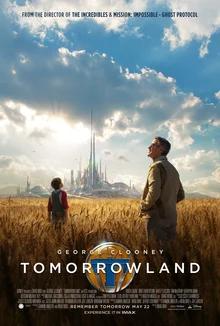
Tomorrowland
Optimistic teenager Casey Newton receives a mysterious pin that, when touched, drops her into a vision of Tomorrowland — a gleaming hidden city of impossible future technology. Tracking down the pin's origin leads her to Frank Walker, a disillusioned former boy-genius who was exiled from that city decades ago, and together they race to understand why humanity's brightest possible future has been sealed away and left to die.
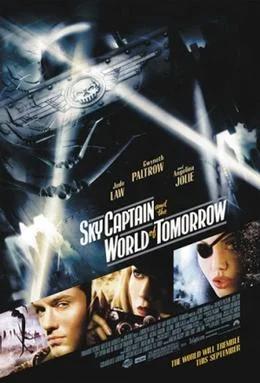
Sky Captain and the World of Tomorrow
1939, an alternate New York besieged by giant robots stomping through Manhattan. Mercenary pilot Joe 'Sky Captain' Sullivan and journalist Polly Perkins — his ex — race to uncover who is behind the attacks, chasing the trail across the globe to a hidden island fortress where a mad scientist's decades-old plan for 'the world of tomorrow' is finally coming to fruition.
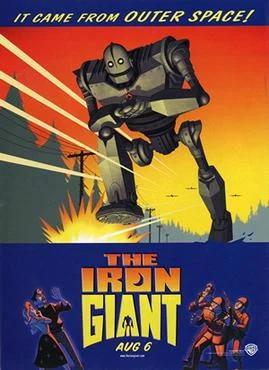
The Iron Giant
Maine, 1957. Young Hogarth Hughes discovers a colossal robot that fell from space, its memory wiped, hiding in the woods behind his house. As Hogarth teaches the Giant about the world — and about choice — a paranoid government agent closes in, convinced the visitor is a Cold War weapon that must be destroyed before it destroys them first.
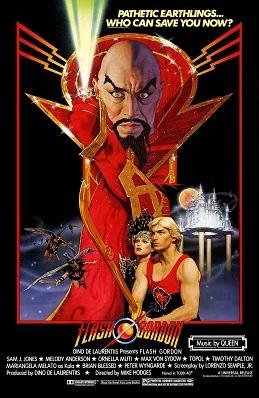
Flash Gordon
Football star Flash Gordon, travel agent Dale Arden and eccentric scientist Dr. Hans Zarkov are pulled through space to the planet Mongo, ruled by the tyrannical Ming the Merciless — who has set Earth in his crosshairs purely for sport. Flash must rally Mongo's warring kingdoms, the hawk-men of Sky City and the forest-dwelling Arboria, into a single rebellion before Ming's whim wipes out his home planet.
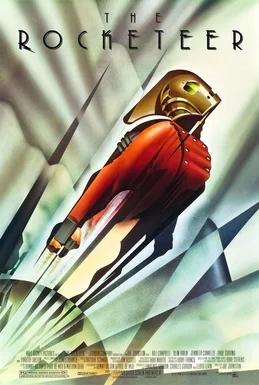
The Rocketeer
1938, Los Angeles. Stunt pilot Cliff Secord stumbles onto a prototype jetpack hidden in his hangar by gangsters — and straps it on. As word of a flying man spreads, Cliff finds himself hunted by Neville Sinclair, a matinee-idol movie star secretly working for Nazi agents desperate to recover the rocket before it reaches Germany, with only his mechanic Peevy and his girlfriend Jenny standing between the jetpack and the Third Reich.
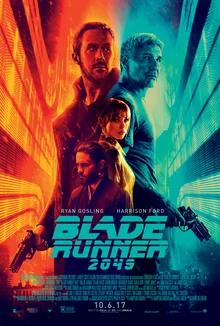
Blade Runner 2049
Thirty years after the original, K is a new-model replicant working as a blade runner for the LAPD, retiring older rogue models without complaint — until a routine job unearths a buried secret: evidence that a replicant once gave birth. The discovery could break the wall between the born and the built, and it sends K hunting for a child hidden decades ago, for a vanished blade runner named Deckard, and for an answer about himself he wants too badly to trust.
Comments
Sign in to join the conversation
No comments yet. Be the first!
Advertisement