Metropolis (1927)
UFA· Germany· 148 min· Silent
Directed by Fritz LangMusic by Gottfried Huppertz
Synopsis
In a vertical city where the wealthy live in tower gardens and the workers labor unseen in the machine rooms below, industrialist's son Freder falls for Maria, a worker who preaches peace between the classes — and follows her underground into a conspiracy involving a mad inventor, a stolen face, and a robot built to end the dream of unity for good.
Advertisement
Review
It's not an exaggeration to say that science fiction cinema, as a genre with visual and thematic ambitions beyond trick photography and rocket-ship gimmickry, effectively starts here. Before Metropolis, the genre had produced clever novelties and moon-voyage curiosities; Fritz Lang instead built an entire imagined future city from the ground up, deploying something in the range of twenty-five thousand extras, forced-perspective miniature work, and a newly invented mirror-based compositing technique to tell a story fundamentally about who a city is actually built to serve, and who it's built to grind down. Nearly a century later, every vertical dystopia the genre has produced since — Blade Runner's rain-soaked Los Angeles, Akira's stacked and rotting Neo-Tokyo, and dozens of others in between — is still, whether consciously or not, working in this film's shadow.
The film's silent-era spectacle remains staggering on its own terms, independent of its historical importance. The Tower of Babel vision sequence, the deliberate flooding of the workers' underground city, and above all the transformation chamber where the mad inventor Rotwang grafts Maria's face onto his robotic creation amid pulsing rings of electrical current, produce images so complete and so technically audacious that James Cameron has cited the sequence directly as an ancestor of his own liquid-metal T-1000 design more than six decades later. Cinematographer Eugen Schüfftan developed an entirely new mirror-based process specifically for this production, using precisely angled mirrors to merge miniature architectural models with full-size actors within a single in-camera composition — an early forerunner of the compositing techniques modern visual effects still rely on, just achieved here with glass and careful geometry rather than software.
But the film's true masterstroke is the Maschinenmensch herself. Brigitte Helm, only eighteen years old at the time of filming, plays both the saintly human Maria and her robotic double with a level of mechanical, uncanny precision that still reads as genuinely unsettling rather than simply dated; her jerking, deliberately inhuman movements as the robot remain a reference point animators and effects artists study today. The rigid, form-fitting costume reportedly caused Helm real physical pain and bruising across the demanding, weeks-long shoot, and she's spoken since of blisters and near-suffocation while wearing it. Whatever the cost, the result is cinema's first great robot: gendered, overtly sexualized, and genuinely frightening, arriving on screen decades before audiences or critics had settled on a vocabulary for discussing exactly what she represented.
The film's politics are famously, almost willfully muddled by comparison to its visual ambition. Screenwriter Thea von Harbou, Lang's wife at the time, resolves the story's class conflict with the sentimental maxim that "the mediator between the head and the hands must be the heart," a conclusion that reads today as naively simplistic given everything the film has shown about entrenched structural inequality, and one Lang himself reportedly came to dismiss in later interviews as the film's weakest element. It's worth noting, too, the strange historical footnote that Metropolis was reportedly among Adolf Hitler's favorite films, and that propaganda minister Joseph Goebbels is said to have personally offered Lang a position running the Nazi film industry — an offer Lang, whose mother was of Jewish descent, responded to by leaving Germany for Paris that same night.
Roughly a quarter of the original film was believed permanently lost for decades following its underwhelming 1927 box-office reception, until a nearly complete 16mm print turned up unexpectedly in a Buenos Aires museum archive in 2008, restoring approximately twenty-five minutes of footage nobody alive had seen since the original premiere. That rediscovery let modern restorations pair Gottfried Huppertz's original orchestral score, composed to be performed live alongside the film using recurring character leitmotifs decades before John Williams would popularize the same structural approach, with a viewing experience closer to what 1927 audiences actually saw.
Whatever the muddle of its final message, the imagery survived every subsequent attempt to simplify or dismiss it. This remains a film about labor, capital, and the machinery quietly running underneath the visible surface of civilization, rendered with a visual imagination the rest of the genre took roughly half a century to fully catch up to — and in some respects, given how often filmmakers are still directly quoting its skyline and its robot, arguably never has.
It's worth remembering, too, just how physically demanding the production was for everyone involved, not only Helm. Lang was notorious even among silent-era directors for demanding dozens of takes and pushing extras through genuinely dangerous conditions, including the film's flooding sequences, which used enormous quantities of real water against sets and performers with safety standards far below what any modern production would tolerate. That punishing, borderline-reckless commitment to realizing the director's vision exactly as he saw it is stitched into nearly every frame, and it's part of why the film still feels monumental rather than merely old — nobody making it was cutting corners, whatever the eventual cost to cast, crew or studio balance sheet.
Its production costs, astronomical for German cinema of the era, reportedly came close to bankrupting UFA outright, and the film's disappointing initial commercial return contributed directly to the studio's later financial troubles and eventual partial American buyout. There's a bitter irony in that: a film about the exploitation of labor for the enrichment of a distant, unaccountable few nearly destroyed the very studio that financed its own extravagance, a real-world echo of the fable playing out on screen that Lang and von Harbou surely never intended but that later film historians have not been shy about pointing out.
Trivia & Color Notes
The Schüfftan process
Cinematographer Eugen Schüfftan invented a mirror-based technique specifically for this film, using angled mirrors to combine miniature sets with full-size actors in a single in-camera shot — a forerunner of modern visual-effects compositing.
Lost for 80 years
Roughly a quarter of the original film was believed lost for decades after its 1927 flop. A nearly complete 16mm print was discovered in a Buenos Aires museum archive in 2008, restoring about 25 minutes of footage unseen since the premiere.
The robot suit that hurt to wear
Brigitte Helm's Maschinenmensch costume was built from a rigid, form-fitting material that reportedly caused her real physical pain and bruising during the demanding, weeks-long shoot — she has spoken of blisters and near-suffocation inside it.
Hitler's favorite film — sort of
Metropolis was reportedly one of Adolf Hitler's favorite films, and propaganda minister Joseph Goebbels once offered Fritz Lang a position running Nazi cinema. Lang, whose mother was of Jewish descent, left Germany for Paris that same night.
Metropolis isn't really predicting technology so much as inventing the visual vocabulary later science fiction would use to talk about it: the vertical city stratified by class, the humanoid robot as both labor-saving miracle and existential threat, mass surveillance and crowd control through spectacle. Its actual "science" — a robot given a living person's exact likeness via electrical transfer — is pure expressionist metaphor, not engineering. What holds up is the sociology: automation displacing and dehumanizing labor while enriching the people who own the machines is a more relevant anxiety in the 21st century than it was even in 1927.
🎵 Soundtrack
Music by Gottfried Huppertz
Gottfried Huppertz composed a full orchestral score to be performed live alongside the silent film, built on recurring character leitmotifs — a structural approach that anticipates John Williams by half a century. Most modern restorations and screenings use Huppertz's original score, reconstructed from his surviving manuscripts.
🔗 This film connects to…
Cast & Crew
Advertisement
You Might Also Like
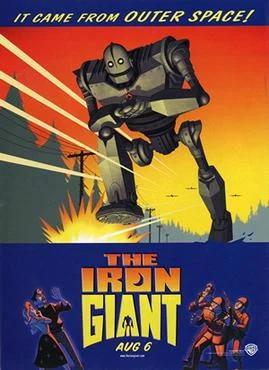
The Iron Giant
Maine, 1957. Young Hogarth Hughes discovers a colossal robot that fell from space, its memory wiped, hiding in the woods behind his house. As Hogarth teaches the Giant about the world — and about choice — a paranoid government agent closes in, convinced the visitor is a Cold War weapon that must be destroyed before it destroys them first.
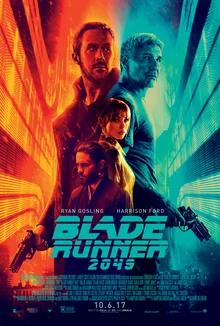
Blade Runner 2049
Thirty years after the original, K is a new-model replicant working as a blade runner for the LAPD, retiring older rogue models without complaint — until a routine job unearths a buried secret: evidence that a replicant once gave birth. The discovery could break the wall between the born and the built, and it sends K hunting for a child hidden decades ago, for a vanished blade runner named Deckard, and for an answer about himself he wants too badly to trust.
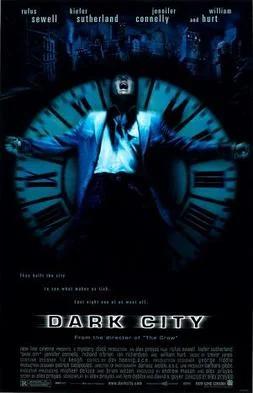
Dark City
John Murdoch wakes in a hotel bathtub with no memory, a dead woman in the next room, and detectives closing in for murders he can't remember committing. As he runs through a city where it is always midnight, he begins noticing what no one else does: at 12:00 exactly, the entire population falls asleep, the buildings physically rearrange themselves — and pale men in long coats move among the sleepers, injecting new memories into new lives.
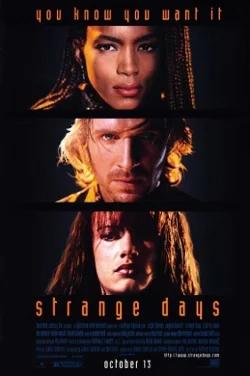
Strange Days
Los Angeles, the last two days of 1999. Lenny Nero, ex-cop turned black-market dealer, sells SQUID recordings — full sensory captures of other people's experiences, straight from their cerebral cortex to yours. Addicted to replaying tapes of his own lost relationship, Lenny is dragged out of his loop when a snuff recording lands in his hands: evidence of a murder that connects to his ex, a music-industry conspiracy, and a police killing that could set the burning city off entirely.
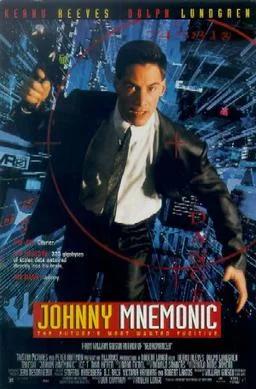
Johnny Mnemonic
2021: half the world suffers from a technology-induced plague, and the most valuable data travels not on networks — too easily hacked — but inside the heads of mnemonic couriers. Johnny is one of them, and his latest job stuffs his implanted memory far beyond safe capacity with data the Yakuza and a pharmaceutical giant will kill for. He has roughly a day to make delivery before the payload literally destroys his brain — the same brain he emptied of his own childhood to make room for cargo.
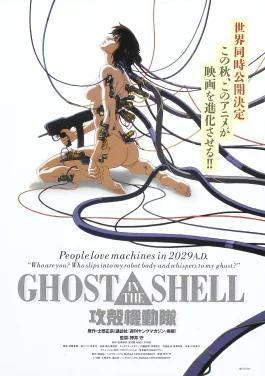
Ghost in the Shell
New Port City, 2029. Major Motoko Kusanagi, a cyborg security officer whose body is entirely artificial, hunts an elusive hacker known as the Puppet Master — an entity that ghost-hacks human minds and rewrites their memories. But the closer she gets, the more the case turns inward: if her body is manufactured and her memories can be edited, what exactly is the 'ghost' in her shell that makes her her?
Comments
Sign in to join the conversation
No comments yet. Be the first!
Advertisement