Close Encounters of the Third Kind (1977)
Columbia Pictures· USA· 138 min· English
Directed by Steven SpielbergMusic by John Williams
Synopsis
After a close encounter with a UFO, Indiana power-company lineman Roy Neary becomes obsessed with a mountain shape he can't explain — one of hundreds of ordinary people worldwide being quietly invited to a rendezvous the government is racing to keep secret.
Advertisement
Review
Steven Spielberg's Close Encounters of the Third Kind opened in November of 1977, five months after Star Wars had already rewritten the commercial rules of the genre, and it's worth pausing on how differently the two films imagine the same basic premise: something is out there, and it's coming closer. Where Lucas built a war, Spielberg built something closer to a religious conversion narrative, one that happens to feature landing lights instead of a burning bush. The aliens in this film never fire a weapon. They communicate in color and in a five-note musical phrase, and the entire back half of the movie is essentially one long, patient act of translation between two species who have decided, for reasons the film never fully explains and doesn't need to, that they'd rather talk than fight. It's a startlingly gentle premise for a studio picture of this scale, and it remains the boldest bet of Spielberg's early career.
The reason the film still lands, decades after its wonder-of-first-contact premise has been imitated to the point of cliché, is that Spielberg refused to let the wonder exist in a vacuum. Richard Dreyfuss's Roy Neary, an ordinary Indiana power-company lineman who has one close encounter and cannot let it go, is not portrayed as a noble visionary. He's portrayed as a man coming apart. His obsession with a mountain shape he's seen in visions but can't identify curdles into something genuinely frightening for his wife and children to witness — there's a sequence where he builds a room-sized model of Devils Tower out of dirt, plants and furniture in his living room, sobbing, while his family watches in something closer to fear than sympathy, and it plays less like inspiration than a breakdown. Teri Garr, as his wife Ronnie, gets one of the most underappreciated performances in the film precisely because she refuses to be scenery; she's furious, and the film lets her be furious, right up until she takes the kids and leaves. Spielberg, who became a father himself in the years after making this film, has said in interviews since that he isn't sure he'd write that ending — Roy ultimately choosing to leave his family behind and board the mothership — the same way today. That unresolved tension between the pull of transcendence and the cost of walking away from the people who need you is the film's real subject, far more than the aliens are, and it's what keeps the film from curdling into pure spectacle.
Douglas Trumbull's visual effects work, which had already reshaped the genre once on 2001: A Space Odyssey nearly a decade earlier, does something genuinely different here: rather than making the alien technology feel cold and monolithic the way HAL's ship did, he renders the UFOs as living carnivals of light, warm and almost playful, closer to fireworks or aurora than to hardware. The mothership itself, when it finally arrives at the Devils Tower rendezvous, is less a machine than an event — a wall of light the size of a city, dropping through the clouds with the gravity of a cathedral organ note. Trumbull achieved much of the cloud and light work using techniques he'd essentially invented on the spot, including injecting tempera paint into water tanks at variable densities and filming the resulting churn at high speed to create the illusion of impossible, roiling scale. None of it looks dated. That's rare for effects work from this specific era of the genre, most of which reads today as charmingly of its time; Trumbull's work here still reads as simply beautiful.
The film's title itself is not marketing invention but borrowed, quite deliberately, from real scientific taxonomy. Astronomer J. Allen Hynek, who spent years as a scientific consultant to the U.S. Air Force's official UFO investigation programs before becoming one of the field's most prominent voices, developed a genuine classification system for reported encounters, and a "close encounter of the third kind" — direct observation of occupants, rather than merely a light in the sky or physical traces — is his actual third category. Hynek consulted directly on the production and makes a wordless cameo at the finale, pipe in hand, watching the mothership land with the same awestruck expression the film is clearly hoping the audience shares. That grounding in a real, if fringe, scientific framework gives the film's wilder speculative elements — government cover-ups, mass visions implanted in ordinary people across the globe — a texture of plausibility they wouldn't otherwise earn.
What ultimately distinguishes Close Encounters from the parade of alien-contact films it inspired is its almost total lack of cynicism. There is no evil general trying to shoot down the UFO for personal gain, no last-act betrayal, no twist revealing hostile intent behind the aliens' patience. François Truffaut, the celebrated French New Wave director making one of his only English-language film appearances, plays the French scientist Claude Lacombe with a kind of hushed, professional wonder that sets the tone for how the film wants scientists themselves to be portrayed: not as obstacles or skeptics, but as some of the only people paying proper attention. The film trusts that first contact, if it ever actually happened, might be less like an invasion and more like the moment religious traditions across every culture have tried to describe for millennia — an encounter with something larger than the self, arriving without malice, and changing everyone who witnesses it whether or not they were ready to be changed.
Watching it again after Star Wars has spent nearly fifty years defining what "big" science fiction is supposed to look like, Close Encounters plays almost like a rebuttal nobody asked Spielberg to write. It says the genre doesn't need a war to justify its spectacle. Sometimes the biggest possible stakes are just: does this ordinary man get to see the thing he was promised, and is it worth what it costs him to go looking for it. Few films before or since have made that question feel this enormous.
Trivia & Color Notes
Hynek's real scale
A 'close encounter of the third kind' — observation of occupants — is a genuine category from astronomer J. Allen Hynek's UFO classification. Hynek consulted on the film and appears at the landing site, pipe in hand.
The mothership's stowaways
Look closely at the mothership model (now in the Smithsonian): its greebled surface hides an R2-D2, a mailbox, a VW bus and a small cemetery — gifts from the model makers to eagle-eyed viewers.
A hangar bigger than a stage
No soundstage could hold the Devils Tower landing site, so production converted a WWII dirigible hangar in Mobile, Alabama — six times the size of Hollywood's biggest stage.
Clouds in a water tank
The roiling cloud formations were created by injecting white tempera paint into tanks of salt and fresh water, filmed at high speed — a Trumbull technique later reused across the genre.
Mashed potato mountain
Dreyfuss sculpting Devils Tower out of mashed potatoes was so iconic that 'mashed potato moment' became shorthand among filmmakers for an obsession the audience can see before the character understands it.
The film takes UFO folklore seriously but grounds it in a real scientific framework: the title comes from astronomer J. Allen Hynek's actual classification system for UFO reports (Hynek cameos at the finale). The musical-mathematical communication scheme is a lovely dramatization of the real idea that mathematics and physics would be the only shared language with an alien intelligence. The spectacle around it — government cover-ups, implanted visions — is pure speculation.
🎵 Soundtrack
Music by John Williams
John Williams composed the five-note motif before filming, testing over 300 combinations with Spielberg. The score dissolves the line between sound effect and music — communication itself becomes the orchestra.
🔗 This film connects to…
- E.T. the Extra-Terrestrial (1982)— Same director: Steven Spielberg
- Blade Runner (1982)— Same effects master: Douglas Trumbull
- Star Wars (1977)— Same composer: John Williams (both 1977!)
- Silent Running (1972)— Same effects artist: Douglas Trumbull
- Star Trek: The Motion Picture (1979)— Same effects artist: Douglas Trumbull
- Contact (1997)— Same theme: patient, hopeful first contact
Cast & Crew
Advertisement
You Might Also Like

Tomorrowland
Optimistic teenager Casey Newton receives a mysterious pin that, when touched, drops her into a vision of Tomorrowland — a gleaming hidden city of impossible future technology. Tracking down the pin's origin leads her to Frank Walker, a disillusioned former boy-genius who was exiled from that city decades ago, and together they race to understand why humanity's brightest possible future has been sealed away and left to die.
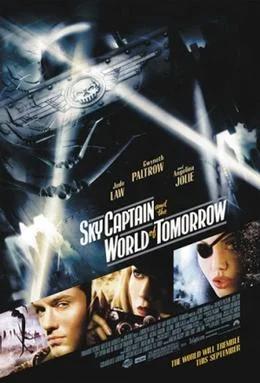
Sky Captain and the World of Tomorrow
1939, an alternate New York besieged by giant robots stomping through Manhattan. Mercenary pilot Joe 'Sky Captain' Sullivan and journalist Polly Perkins — his ex — race to uncover who is behind the attacks, chasing the trail across the globe to a hidden island fortress where a mad scientist's decades-old plan for 'the world of tomorrow' is finally coming to fruition.
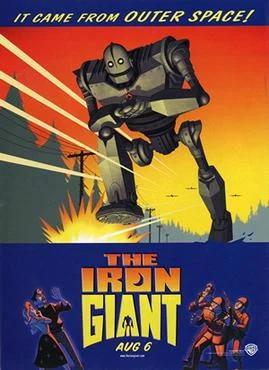
The Iron Giant
Maine, 1957. Young Hogarth Hughes discovers a colossal robot that fell from space, its memory wiped, hiding in the woods behind his house. As Hogarth teaches the Giant about the world — and about choice — a paranoid government agent closes in, convinced the visitor is a Cold War weapon that must be destroyed before it destroys them first.
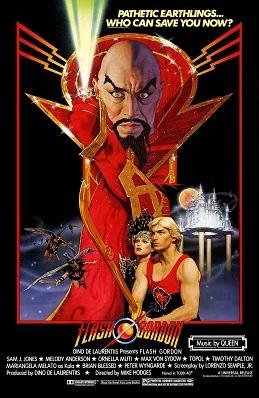
Flash Gordon
Football star Flash Gordon, travel agent Dale Arden and eccentric scientist Dr. Hans Zarkov are pulled through space to the planet Mongo, ruled by the tyrannical Ming the Merciless — who has set Earth in his crosshairs purely for sport. Flash must rally Mongo's warring kingdoms, the hawk-men of Sky City and the forest-dwelling Arboria, into a single rebellion before Ming's whim wipes out his home planet.
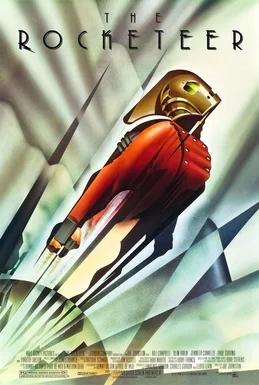
The Rocketeer
1938, Los Angeles. Stunt pilot Cliff Secord stumbles onto a prototype jetpack hidden in his hangar by gangsters — and straps it on. As word of a flying man spreads, Cliff finds himself hunted by Neville Sinclair, a matinee-idol movie star secretly working for Nazi agents desperate to recover the rocket before it reaches Germany, with only his mechanic Peevy and his girlfriend Jenny standing between the jetpack and the Third Reich.
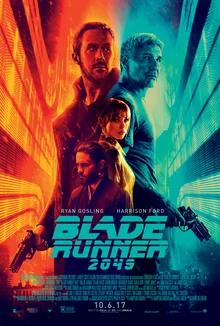
Blade Runner 2049
Thirty years after the original, K is a new-model replicant working as a blade runner for the LAPD, retiring older rogue models without complaint — until a routine job unearths a buried secret: evidence that a replicant once gave birth. The discovery could break the wall between the born and the built, and it sends K hunting for a child hidden decades ago, for a vanished blade runner named Deckard, and for an answer about himself he wants too badly to trust.
Comments
Sign in to join the conversation
No comments yet. Be the first!
Advertisement